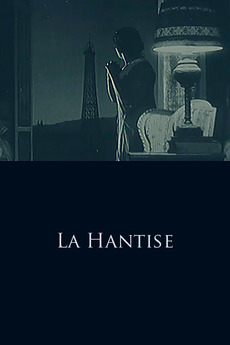
La Hantise (or Obsession, for those of us not well-versed in French), is a French silent film from 1912 that chronicles a woman’s obsessive fear for her husband’s safety after an encounter with a palm reader at a party.
Plot
At the beginning of the film, Jacques Trevoux receives a letter from his friend advising him to postpone his transatlantic trip due to the large number of icebergs in the Atlantic Ocean, a condition that is making transatlantic ship travel dangerous. Jacques is reluctant to cancel, but his wife and son plead with him, so he acquiesces and plans to sail at a later date.
A few days later, Jeanne meets a popular palm reader named Josepha at a party. Josepha reads Jeanne’s palm and supposedly discovers something so troubling that she refuses to share her findings with her client. Well, of course, Jeanne can’t leave it at that—she has to find out what the palm reader has seen in her palm, so she arranges a private meeting at the Trevoux home.
When Josepha meets with Jeanne, the former reveals that the latter will face the imminent loss of a close loved one. Jeanne keeps the findings to herself and does not reveal them to her son or husband. Meanwhile, Jacques decides that it’s time to rebook his transatlantic trip, this time on the Titanic’s maiden voyage. He will board at Cherbourg, France.
Once Jacques leaves for his trip, Jeanne, distraught over the palm reader’s prediction, writes to her godfather, Julien, asking him to come stay with her. When Julien arrives, Jeanne tells him about the palm reader’s prediction, but he laughs it off, turning his attention to the mail and newspaper that have just arrived. Among the items is a postcard from Jacques sent from the Titanic. But there’s something else: splashed across the front page of the the newspaper is a shocking report that the Titanic has sunk, killing 1,800 people. Jeanne and her son are, of course, devastated. In fact, the kid is so grief-stricken that he falls gravely ill.
But no worries. Later, Jeanne receives another message from Jacques that he was among those saved by the Carpathia. That’s great news…except that the palm reader’s prediction is still on her mind, and she becomes worried that since Jacques didn’t die, their son may be in danger of succumbing to that fate.
It Doesn’t Get Much Better Than This
I like this movie, and one of the reasons is because it was produced so soon after the Titanic sank. It was released in 1912, the year of the sinking, and until a few months ago, I’d never even heard of it. I only know of two other films about the Titanic that were filmed and released in 1912: Saved from the Titanic and Un Nacht en Eis (In Night and Ice).
Saved from the Titanic was written by Dorothy Gibson, a famous actress in 1912 and the star of the film. She was a first-class passenger who survived the sinking of the Titanic, and when she arrived in New York after being rescued, she began working on Saved from the Titanic, which was released later that year.
I would love to see Saved from the Titanic. I mean, a Titanic film written by and starring an actual survivor? For someone who’s into Titanic film history, that would be amazing. But the chances of me actually seeing the finished product are extraordinarily slim. All known copies of the film were destroyed by a studio fire in 1914, and no copies are known to have survived. All that’s left are a few stills. It’s possible that a copy might crop up one day—it’s happened before with films that were thought to have been lost, but it’s not likely with this one.
Something along the lines of La Hantise is the next best thing. Everyone involved in the production of the film was actually alive when the Titanic sank. The fashions that you see in the film, the hairstyles, the furniture—all of that is authentic to the period. It’s not people from a later era trying to recreate the environment after the fact. One scene that I love is the scene where Jeanne and her son drop Jacques off at the train station. You see their car pull up to the side walk, and there’s all this action going on in the background, people going about their lives in the hustle-bustle of an early 20th-Century city. It’s nothing out of the ordinary, really, but I find it fascinating.
A Tale of Two Versions
My experience viewing this film was a reminder of how important it is to check multiple versions of old films like this. Many films from this era have expired copyrights which no one has renewed, so there’s no infringement on who can display them or where. This is why I saw two versions of this film on YouTube, and the experiences of watching each couldn’t have been more different.
It’s interesting how a few details can totally change how you view something. The first version of the film I viewed was a shortened, altered version, but I didn’t find this out until after I’d watched it. During my viewing of the film, I had no idea that Madame Trevoux’s first name was Jeanne until I was deep into the film, and that was only because you can see her name when you see the letter that she wrote to Julien. Up until that point, no one had addressed her by her first name. I thought it was a weird oversight, considering that she’s the main character in the film. Later, during my viewing of a second version of the film, I found out that the conclusion I’d reached was not at all accurate. I’ll explain why in a minute.
The first version of the film also had no musical accompaniment whatsoever. I kept checking to see if maybe I’d somehow muted the video accidentally, but I hadn’t. That was just the way this version was. I mentioned earlier that this version of the film wasn’t even the full film. The last few minutes were missing, having been replaced by a card that explains what happened at the end of the film.
By chance, I found a second version of the film that hadn’t shown up in my results when I first searched for the film (or maybe it had, and I’d simply overlooked it). The introductory frames told me that this version had been distributed by Kino, a company that distributes a lot of old films like this one, so I had high hopes that maybe this would be a full version with the scenes that had been missing from the first version I watched.
Right away, I knew that I had a good version of the film, at least one that was better than the first one I watched. This one had music, and the title cards matched the rest of the film more than those in Version 1 (the cards in the first version of the film seemed like they were added later and were not original to the film). The scenes are so much more impactful with the music, especially the scene depicting the Titanic sinking, which features “Nearer My God to Thee.” Without the music, watching this scene is like watching a toy boat sink in a bathtub.
One scene that I’d found a puzzling in Version #1 of the film made much more sense after I watched Version #2. Here’s what happens: One night, Jeanne looks out the window at what appears to be the Eiffel Tower. Something about the view unsettles her, but in Version #1, there’s no explanation about what it was. Version #2 of the film confirms that Jeanne is indeed looking at the Eiffel Tower and offers an explanation as to why Jeanne was so distraught. Apparently, Jeanne thinks that seeing tower lights come on are a bad omen. There’s no way in the world I would have known that without a title card to explain it.
Version #2 provides a more detailed version of the ending, too. Both versions feature a scene where Julien writes a letter to Josepha requesting a palm reading for his niece. In Version #1, this scene is the very last scene, and it makes no sense whatsoever. It kind of made me think that it was a flashback scene and that Julien had set up that initial meeting between Jeanne and Josepha near the beginning of the movie.
Fast-forward to Version #2. The scene is still in the film, but it’s also accompanied by a title card explaining that Julien and Jeanne have hatched a plan to test whether Josepha is a fake. Jeanne will pose as Julien’s niece and will hide behind a curtain, sticking her hand through so that Josepha can read her palm. The palm reader predicts a glowing future for the bride-to-be. Julien reveals his trickery, and Josepha flees, leaving her purse behind. Julien finds a letter in it: basically, Josepha has been running a con game with an acquaintance, who has advised her to take advantage of as many people as she could. With the exception of the scene where Julien writes the letter, we don’t actually get to see these scenes because they actually are missing. But the key is that the scenes are described on a series of cards, so there’s context here in Version #2 where none exists in Version #1.
In Version #2, we also get to see the final scene of the film, an epilogue which depicts the family enjoying a meal at the table after Jacques returns home. The Trevoux boy is healthy again, and Jeanne has overcome her obsession and her belief in palm readers. Interestingly, the epilogue wasn’t part of the original film and was added in 2007 by a French film studio called Gaumont, which used source material from the original screenplay and an incomplete print held at Archives Francaises du film du CNC.
While I wish that La Hantise featured more Titanic scenes, I’m glad for the one scene that we get featuring the ship. And the historical tidbits about that I gleaned about the era from other scenes do a lot to make up for the lack of Titanic. The film isn’t a must-see if your interest is purely Titanic. However, if you’re interested in the era in addition to the ship, you’ll probably find that it’s worth it, even if you only see it just once.


 Course Correction Studio